
It’s late, the house has gone quiet, and your brain has chosen this exact moment to replay every awkward conversation from the last decade. If you want to know how to calm anxiety at night, the frustrating truth is that willpower doesn’t work — telling an anxious mind to “just relax” is like telling a smoke alarm to stop being loud. What does work is giving your nervous system specific, physical signals that it’s safe to stand down. This article walks you through eight of them, why each one works, and exactly when to reach for which.
To calm anxiety at night, start with your body rather than your thoughts. Slow your breathing so your exhale is longer than your inhale — this is the single fastest way to switch your nervous system out of “alert” mode. Then get the racing thoughts out of your head and onto paper, relax your muscles from feet to face, and keep your bedroom cool and dark. The goal isn’t to stop thinking. It’s to stop your body from treating bedtime like a threat.

Key Takeaways
The short version, in case it’s already 2 a.m. and you need this now.
- Your exhale is the off-switch. Breathing out slowly, longer than you breathe in, activates the part of your nervous system that calms you down — and it works in under two minutes.
- Write the worry down before you try to sleep. A two-minute “brain dump” tells your mind it’s safe to stop rehearsing the thing it’s afraid you’ll forget.
- You can’t relax a tense body with a calm thought. Physical techniques like progressive muscle relaxation and temperature regulation work even when your mind won’t cooperate.
- Anxiety feels worse at night for real, measurable reasons — fewer distractions, an exhausted brain, and a quiet room all amplify the volume.
- The technique matters less than the consistency. A “good enough” routine done every night beats the perfect technique done once.
- If night-time anxiety is severe or constant, it’s a medical conversation, not a willpower problem — and worth raising with a professional.
Why Your Anxious Mind Gets Louder After Dark
There’s a reason your worries seem to wait until the lights are off to show up. During the day, your attention is occupied — work, people, screens, the hundred small decisions that fill your hours. At night, all of that falls away, and your mind, left with nothing to chew on, turns inward. Anxiety doesn’t get bigger at night so much as everything else gets quieter, and suddenly the background hum becomes the only sound in the room.
There’s a biological layer too. Sleep researchers, including Matthew Walker’s lab at UC Berkeley, have shown that going short on sleep amplifies activity in the amygdala — the part of the brain that drives the fear response. So a few rough nights don’t just make you tired. They make your brain more reactive, which makes the next night harder, which makes you more tired. It’s a loop, and the loop is part of why so many people feel stuck. You’re not imagining that it gets worse the longer it goes on.
Lying still also gives your body fewer cues that you’re safe. When you’re upright and moving, your nervous system reads “engaged, fine.” Flat on your back in the dark, your brain has less information to work with, and an anxious brain fills information gaps with worst-case scenarios. The techniques below all work by feeding your nervous system the safety signals it’s missing — through breath, through movement, through temperature, through getting the noise out of your head. None of them require you to win an argument with your own thoughts, which is good, because at 2 a.m. you will lose that argument.

It's rarely a motivation problem. It's five apps and no single page.
Habits in one place, money in another, notes in a third, and nowhere that shows you how the month is actually going. The Digital Life Planner is one spreadsheet that holds all of it and does the arithmetic while you get on with your life.
See how it works →Breathing Techniques That Tell Your Body You’re Safe
The fastest route to a calmer mind runs through your breath, because breathing is the one part of your nervous system you can consciously steer. Your heart rate, your stress hormones, your blood pressure — you can’t will those down directly. But change how you breathe and they follow, because a slow, long exhale activates the parasympathetic nervous system, the “rest and digest” branch that’s the literal opposite of the fight-or-flight state anxiety puts you in.
Technique 1: 4-7-8 breathing. Popularized by Dr. Andrew Weil, this one is built around a long, deliberate exhale. Breathe in quietly through your nose for a count of four. Hold for seven. Then exhale through your mouth, with a soft whoosh, for a count of eight. Repeat the cycle four times. The exact numbers matter less than the ratio — your out-breath is twice as long as your in-breath, and that’s the part doing the work. Research from Stanford Medicine found that just five minutes a day of slow-exhale breathing measurably lowered stress and improved mood in healthy adults. If holding for seven feels like too much, shorten everything but keep the exhale longest. Don’t force it. Lightheadedness means you’re overdoing it, not doing it right.
Technique 2: Box breathing. This is the one used in high-pressure professions where people need to stay calm under genuine stress — it’s a staple of military tactical breathing. You breathe in for four counts, hold for four, breathe out for four, hold for four. Picture tracing the four sides of a square. Where 4-7-8 is good for tipping you toward sleep, box breathing is better when you’re wired and need to come down from a spike of panic first. It’s steadying rather than sedating. A lot of people find it easier to stick with because the even count is simple to remember when your mind is scattered.
One more worth knowing: the physiological sigh — a double inhale through the nose (one normal breath, then a second short top-up sip of air) followed by a long exhale through the mouth. The same Stanford research linked above tested this exact pattern as a five-minute daily practice and found it reduced anxiety more than an equal amount of mindfulness meditation. You can use a few of these sighs on their own the moment you notice your chest tightening, no counting required.
Mental Techniques to Break the Thought Spiral
When the problem is a runaway mind rather than a racing heart, you need techniques that give your thoughts somewhere to go. Trying to suppress a thought makes it louder — that’s a well-replicated finding, the same reason “don’t think about a white bear” guarantees you’ll think about one. So the move is redirection and offloading, not suppression.
There's a version of this that asks you questions back.
An article can tell you what burnout is. A workbook makes you locate where you actually are in it, on paper, in your own handwriting. That's The Burnout Fix — ninety-odd pages of it.
Look at the workbook →Technique 3: The cognitive shuffle. Developed by cognitive scientist Luc Beaudoin, this is a deliberately boring mental exercise that mimics the random, drifting imagery your brain naturally produces right before sleep. Pick a simple word — say, “beach.” Then imagine each item one at a time, with no story connecting them: a ball, then an axe, then a cloud, then a banana. Random, unrelated, vivid for a second, then gone. The reason it works is mechanical: your brain interprets disconnected imagery as a signal that it’s safe to start sleeping, and the task is just engaging enough to crowd out anxious rumination without being interesting enough to wake you up.
Technique 4: The worry window. This comes straight out of cognitive behavioral therapy, and it sounds almost too simple. Instead of fighting worries at midnight, you schedule a dedicated 15-minute “worry window” earlier in the evening — say, 7 p.m. — where you sit down and deliberately worry on purpose, writing it all out. When the same worries surface at night, you tell yourself, genuinely, “I’ve already booked time for this. Not now.” It feels ridiculous the first few times. It also works, because the anxious mind largely keeps rehearsing problems out of a fear that if it stops, you’ll forget or fail to handle them. Giving worry a scheduled slot reassures it that the matter is being taken seriously.
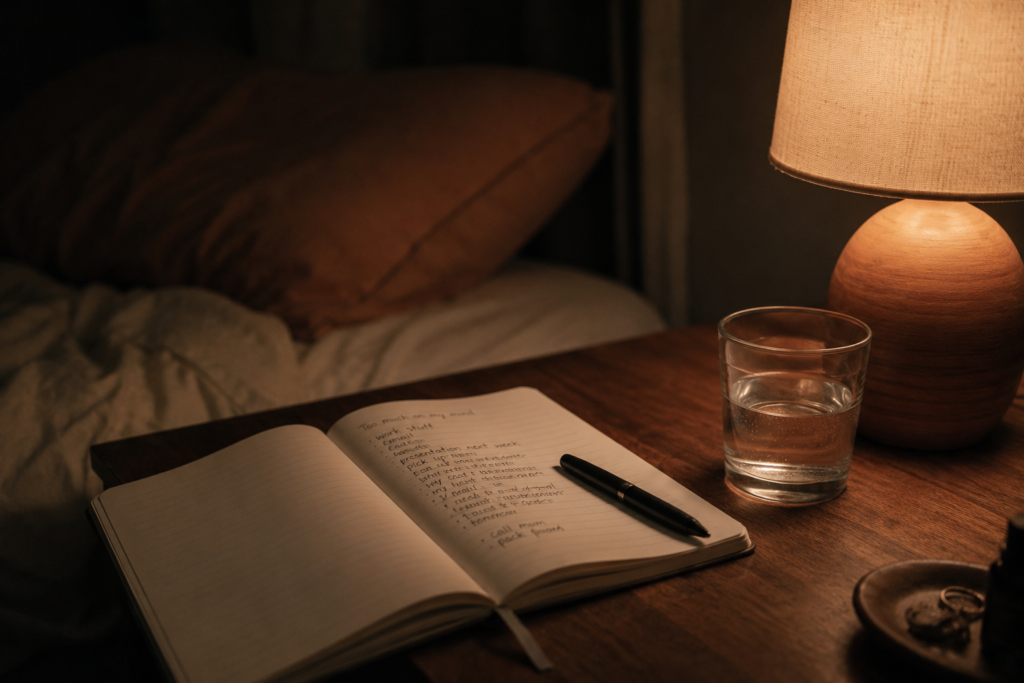
Technique 5: The brain dump. Keep a notebook by your bed. When your mind starts cycling, write everything down — every task, every fear, every half-formed “I need to remember to” — in messy, unfiltered fragments. You’re not journaling or solving anything. You’re externalizing. Your brain holds onto open loops with a low-grade urgency (psychologists call this the Zeigarnik effect — we remember unfinished tasks better than finished ones), and writing a thought down closes the loop enough that your mind agrees to release it. Two minutes of scribbling often does what twenty minutes of trying-not-to-think can’t. If a single worry keeps coming back, write the smallest next action beside it. “Email Dan” is easier to set down than the vague dread of an unanswered problem.
Body-Based Techniques When Your Mind Won’t Cooperate

Some nights your thoughts aren’t even the problem — your body is simply buzzing, tense, too warm, too alert. You can’t think your way out of a tense body, so these techniques work from the outside in, and they’re the ones I reach for when nothing mental is landing.
Technique 6: Progressive muscle relaxation. This is a century-old method developed by physician Edmund Jacobson, and it’s still taught in clinics because it reliably works. You move through your body one muscle group at a time, tensing each hard for about five seconds, then releasing completely and noticing the contrast. Start at your feet — curl your toes tight, hold, let go. Then calves, thighs, glutes, stomach, hands, arms, shoulders, jaw, the muscles around your eyes. The tensing is the trick: it gives your muscles a clear “before” so the release feels like a genuine drop, and it gives your restless attention a physical task. By the time you reach your face, most people notice their whole body has gone heavier. It takes about ten minutes and it’s hard to do while staying anxious.
It's rarely a motivation problem. It's five apps and no single page.
Habits in one place, money in another, notes in a third, and nowhere that shows you how the month is actually going. The Digital Life Planner is one spreadsheet that holds all of it and does the arithmetic while you get on with your life.
See how it works →Technique 7: Cool down on purpose. Your body needs its core temperature to drop by roughly one degree to fall asleep — that dip is part of the biological signal for sleep onset. Anxiety runs you hot, which works directly against this. Two practical moves: keep your bedroom cool, somewhere around 65°F (18°C), which research consistently links to better sleep. And, counterintuitively, take a warm bath or shower about 60 to 90 minutes before bed. A 2019 review found this helped people fall asleep faster, because warming up your skin pulls heat to the surface and away from your core, so your core temperature drops afterward. If you wake in a panic, even sticking your hands or face in cool water for thirty seconds can help interrupt the physical surge — it’s a gentler cousin of the cold-water reset some people use during full panic attacks.
The Wind-Down Routine That Does Half the Work
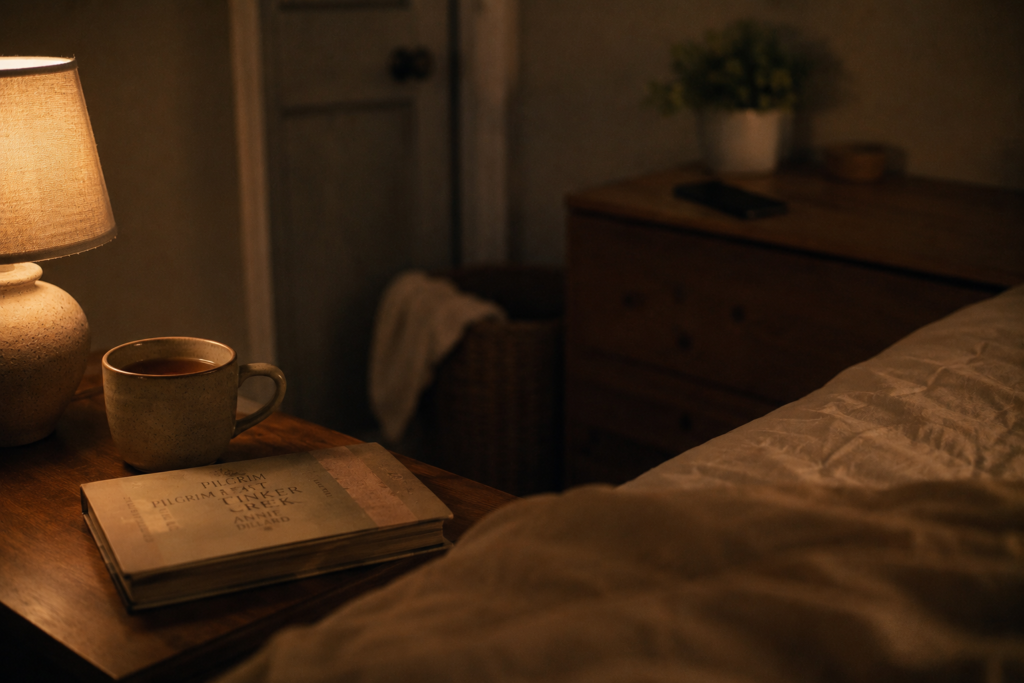
The most underrated technique isn’t something you do in bed at all — it’s the 60 to 90 minutes before it. Your nervous system can’t slam from full-speed daytime mode into sleep on command. It needs a runway, and most night-time anxiety is partly the predictable result of going from a glowing screen and a busy mind straight to lights-out, then being surprised the brain hasn’t caught up.
Technique 8: Build a wind-down ritual. The aim is a consistent, low-stimulation sequence your body learns to read as “we’re heading toward sleep now.” Dim the lights an hour before bed — bright light, especially the blue-heavy light from phones and laptops, tells your brain it’s still daytime and suppresses melatonin, the hormone that makes you sleepy. Put the phone in another room if you can; “I’ll just check one thing” is how a calm body gets pulled back into alertness. Then do the same handful of quiet things in roughly the same order each night: a warm drink, a few pages of a paper book, a stretch, the brain dump from earlier. The specific activities matter far less than the repetition. After a couple of weeks, the routine itself becomes a cue, and your body starts winding down before you’ve consciously decided to. A solid morning routine for mental health helps from the other end too — how you start the day shapes how wired you are by night.
Here’s how the eight techniques compare, so you can grab the right one for the night you’re having:
| Technique | Time it takes | Best for |
|---|---|---|
| 4-7-8 breathing | 2 minutes | Tipping a calm-ish body toward sleep |
| Box breathing | 2–4 minutes | Coming down from a panic spike |
| Cognitive shuffle | 5–15 minutes | A looping, overthinking mind |
| Worry window | 15 min, earlier | Chronic, recurring worries |
| Brain dump | 2–5 minutes | A head full of tasks and open loops |
| Progressive muscle relaxation | ~10 minutes | A physically tense, buzzing body |
| Cooling down | 5–90 minutes | Running hot, wired, can’t settle |
| Wind-down ritual | 60–90 minutes | Preventing the problem in the first place |
Common Mistakes People Make Trying to Calm Anxiety at Night
Even people who know these techniques often undercut them in ways that quietly guarantee they won’t work. These are the patterns I see most.
Checking the clock. The moment you calculate “if I fall asleep now, I’ll get four hours and twelve minutes,” you’ve created a new source of pressure, and pressure is the enemy of sleep. Each glance raises the stakes and the anxiety. Turn the clock to face the wall. If you wake in the night, resist the math entirely — you genuinely do not need to know what time it is, and knowing only hurts.
Trying too hard to fall asleep. Sleep is one of the few things that gets further away the more you chase it. If you treat these techniques as a test you might fail — “is it working yet? why isn’t it working?” — you keep your brain in evaluation mode, which is alert mode. The reframe that helps: you’re not trying to sleep, you’re just resting and breathing, and sleep can show up whenever it likes. Take the pressure off the outcome and the outcome comes easier.
Staying in bed for hours, wide awake. If you’ve been lying there genuinely awake for more than about 20 minutes, get up. This sounds backward, but staying in bed while anxious teaches your brain to associate the bed with stress and rumination. Go to another room, keep the lights low, do something boring, and return only when you feel sleepy. Protecting the bed as a place for sleep — not for fighting your mind — is one of the core principles of clinical insomnia treatment.
Using your phone to “calm down.” Scrolling, reading the news, or even using a meditation app with a bright screen at 2 a.m. tends to backfire. The light wakes you, and the content — even neutral content — re-engages the thinking brain you’re trying to quiet. If you use an app, dim the screen all the way and don’t look at it; let it be audio only.
Most of what you read this week will be gone by Thursday.
That isn't a discipline problem. It's what happens to information you never write down. Beat Information Overload is a free 35-page workbook that turns reading into something that stays.
Get the free workbook No cost · unsubscribe in one clickSaving the techniques for the worst nights only. People tend to reach for these tools the night they’re already spiraling, when they’re hardest to do well. They work far better as a daily practice. A few rounds of breathing on an ordinary evening trains the response so it’s available — almost automatic — on the night you actually need it.
A note on when this is bigger than a routine. This article is educational and isn’t a substitute for medical advice. Occasional restless, anxious nights are normal. But if anxiety keeps you up most nights, shows up with physical symptoms like a racing heart or chest tightness, or comes with low mood that won’t lift, please treat it as a health issue worth raising with a doctor or therapist — it’s common, it’s treatable, and you don’t have to white-knuckle it alone. If you ever feel unsafe or in crisis, in the US you can call or text 988 (the Suicide & Crisis Lifeline), any time, for free.
Frequently Asked Questions
Why does my anxiety get worse at night? At night there are fewer distractions, so your mind turns inward and the worries you outran all day finally catch up. Being tired also makes the brain’s fear circuitry more reactive, and lying still in the dark gives your nervous system fewer cues that you’re safe. It’s a real pattern, not a personal failing — and the same things that quiet the body can quiet it.
What is the fastest way to calm anxiety at night? Slow, extended-exhale breathing is the fastest reliable method. Breathe in through your nose for about four seconds and out through your mouth for about eight, making the out-breath clearly longer than the in-breath. A few rounds of this directly activates the calming branch of your nervous system and lowers your heart rate, usually within a minute or two, without needing to change a single thought.
Should I get out of bed if I can’t sleep? Yes, if you’ve been awake and anxious for roughly 20 minutes or more. Staying in bed while your mind races teaches your brain to link the bed with stress. Get up, keep the lights dim, do something quiet and boring in another room, and go back only when you feel genuinely sleepy. It protects the bed as a place your body associates with rest.
Does writing my worries down before bed actually help? For most people, yes. Writing worries and unfinished tasks down externalizes them, which closes the mental “open loops” your brain keeps rehearsing out of fear you’ll forget. A short, messy two-minute brain dump often settles a racing mind faster than trying to suppress the thoughts, which usually makes them louder instead of quieter.
Is it normal to wake up at 3 a.m. with anxiety? It’s extremely common. Natural shifts in sleep cycles and stress hormones in the early morning can leave you in a lighter, more wakeful state, and an anxious brain seizes that window. The calming techniques here work just as well at 3 a.m. as at bedtime — reach for breathing or a brain dump rather than your phone, and avoid checking the time.
Can night-time anxiety be a sign of something more serious? Sometimes. Occasional anxious nights are normal, but persistent night-time anxiety can be part of an anxiety disorder, depression, or another treatable condition — and chronic sleep loss worsens both. If it happens most nights, comes with strong physical symptoms, or affects your daytime life, it’s worth talking to a doctor or therapist. These are common and very treatable.
It's rarely a motivation problem. It's five apps and no single page.
Habits in one place, money in another, notes in a third, and nowhere that shows you how the month is actually going. The Digital Life Planner is one spreadsheet that holds all of it and does the arithmetic while you get on with your life.
See how it works →The One Thing to Remember
If you take only one idea from all of this, make it the exhale: a long, slow out-breath is the most direct, reliable tool you have for telling an anxious body it’s safe to rest, and it works any night, in any bed, with nothing but your own breath. Pick one or two of these techniques to start — not all eight — and use them on ordinary nights, not just the bad ones, so they’re ready when you need them. The quiet you’re looking for is mostly a matter of giving your nervous system the right signal, then getting out of its way.

Quiet the noise — without burning your phone in a field.
Get Beat Information Overload free, plus the occasional calm, no-hype note from me.