

Your anxious thoughts have one favorite trick: they loop. The same worry, the same imagined disaster, circling for the hundredth time while you’re trying to fall asleep or get through a workday. Journaling for anxiety breaks that loop by getting the thought out of your head, where it spins forever, and onto paper, where it suddenly looks smaller and a lot more answerable. This article gives you five journaling methods and dozens of specific prompts to quiet overthinking — not the vague “just write your feelings” advice, but the exact questions that actually settle a racing mind.
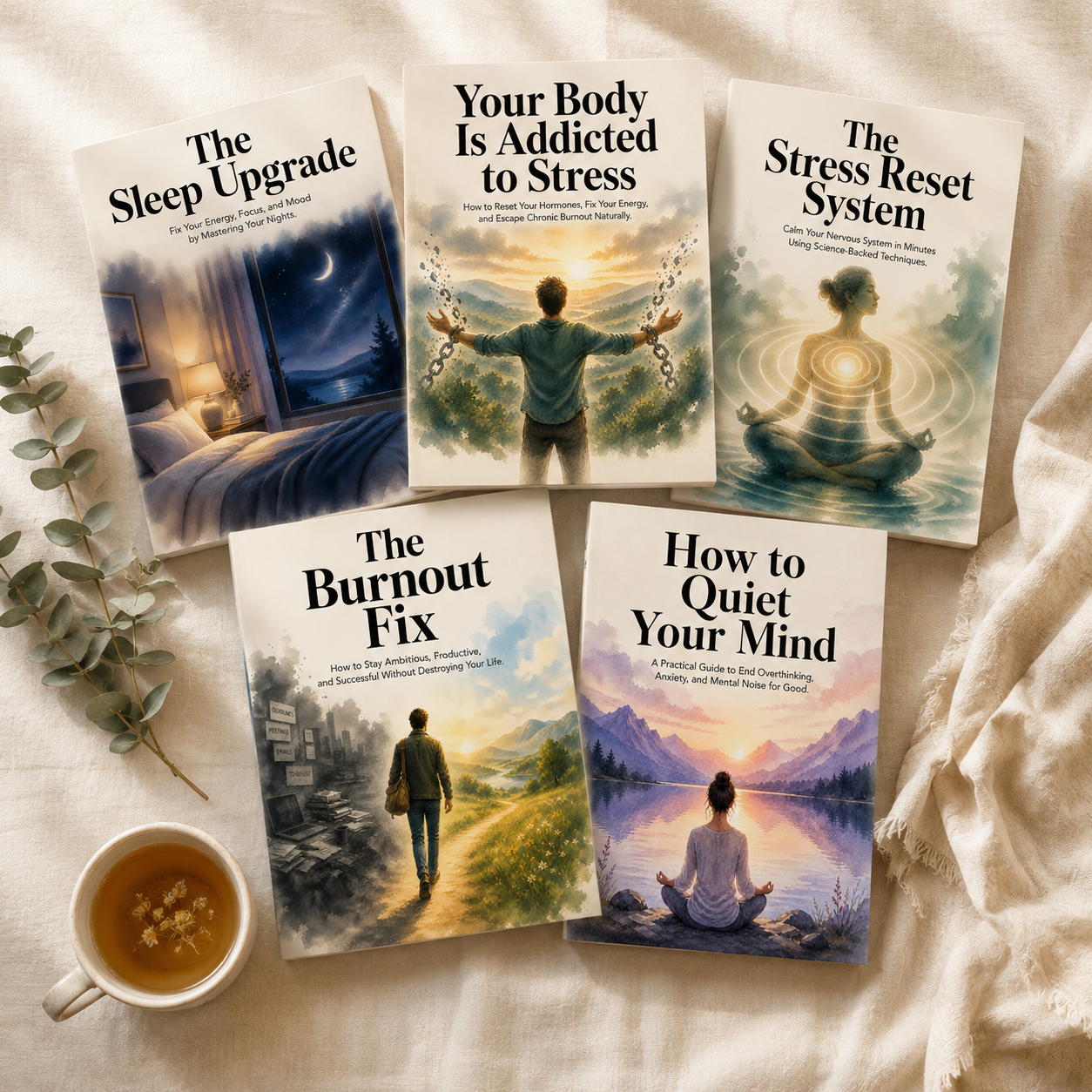
The Calm Reset Bundle
5 practical guides for sleep, stress, anxiety and burnout. Designed for article readers who want real-world solutions.
Journaling for anxiety works by moving worries out of your head — where they loop endlessly — and onto paper, where they become specific, finite, and easier to question. Start with a two-minute brain dump: write down every anxious thought without editing or solving. Then pick the loudest worry and ask, “What’s the actual evidence this will happen? What part of this is in my control?” Naming and challenging thoughts on paper quiets overthinking faster than trying to think your way calm.
Key Takeaways
The gist, before you open the notebook.
- Overthinking lives in your head and shrinks on paper. Writing a worry down makes it specific and finite instead of a vague, looping dread.
- Start messy. A two-minute “brain dump” with no structure or grammar is the fastest way to clear a crowded, racing mind.
- Naming a feeling reduces its grip — simply writing “I feel anxious because…” engages the calmer, problem-solving part of your brain.
- Different anxious moments call for different methods — venting, challenging a thought, or refocusing on what’s good each do a separate job.
- Consistency beats length. A few honest minutes most days does far more than a long entry once a month.
- Journaling is a tool, not a treatment — powerful for everyday anxiety, but not a replacement for professional support when anxiety is severe.
Why Journaling for Anxiety Actually Works
Journaling helps anxiety because it forces a vague, swirling feeling to become concrete words — and concrete words are far easier to handle than formless dread. When a worry stays in your head, it has no edges. It’s just a looping sense that something is wrong, and your brain keeps replaying it precisely because it never gets resolved. The moment you write it down, you’ve given it a shape: a specific fear, about a specific thing, that you can now actually look at. That shift, from “everything is wrong” to “I’m worried that the meeting on Thursday will go badly,” is most of the relief.
There’s solid research behind this. Decades of work by psychologist James Pennebaker established what’s now called the expressive writing paradigm — the finding that writing about emotional experiences for short stretches can improve both mental and physical health. His classic protocol was simple: write about your deepest thoughts and feelings around a difficult experience for 15 to 20 minutes, a few days running, without worrying about spelling or whether it’s any good. Across hundreds of replications, people who did this tended to feel better, and the effect held up well enough that therapists still use versions of it today.
Part of why it works connects to something psychologists call affect labeling — the simple act of putting a feeling into words. Naming an emotion (“I’m anxious,” “I’m overwhelmed and a little scared”) engages the more deliberate, verbal part of your brain and quiets the alarm centers a little. You’re not suppressing the feeling. You’re observing it, which automatically puts a sliver of distance between you and it. Journaling is affect labeling with a pen — and unlike a fleeting thought, what you write stays put, so you can come back, reread, and notice the worry you were certain about last night looks a lot less convincing this morning. The point isn’t to write well. It’s to get honest, on paper, fast.
The Brain Dump: Your First Move When Your Mind Won’t Stop
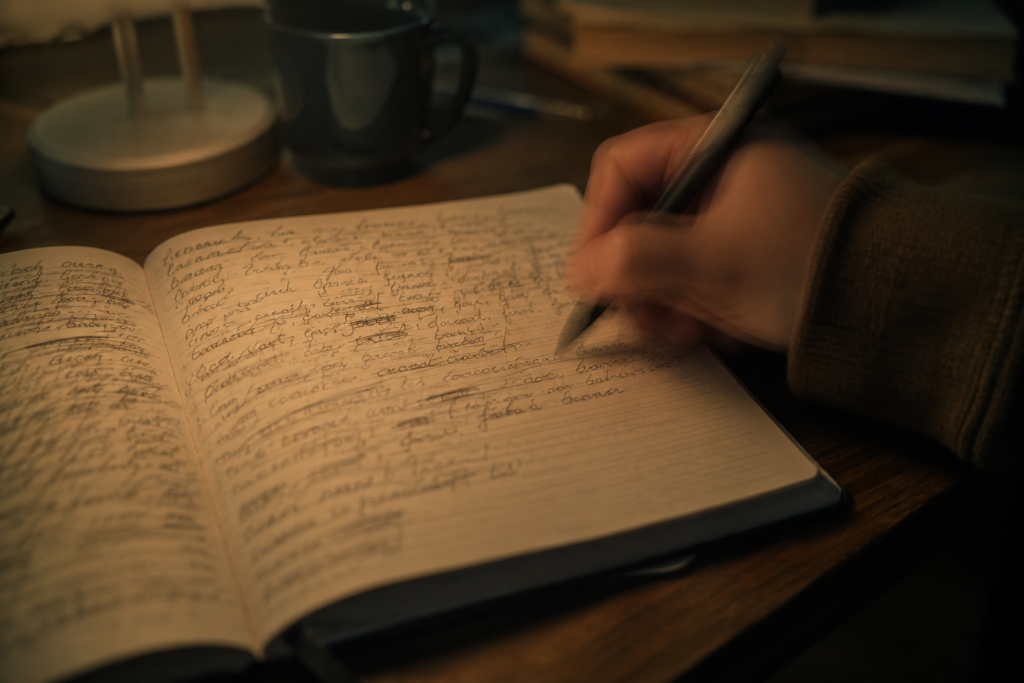
When your head is too crowded to think straight, the brain dump comes first — it’s pure, unfiltered offloading, no structure required. You’re not journaling in any thoughtful sense. You’re emptying. The goal is to get every anxious thought, every nagging task, every half-formed fear out of your mind and onto the page as fast as you can, in whatever messy order they arrive. Set a timer for two to five minutes and write without stopping, without editing, without judging a single word. If all that comes out is “I don’t know what to write, this is stupid, I’m tired, I’m worried about money,” write exactly that. The mess is the point.
It works because your brain holds onto unfinished business with a low, persistent hum of urgency — the same reason you remember the email you haven’t sent better than the ten you have. Writing it down tells your mind the matter is captured and it can stop guarding it. A two-minute brain dump before bed is one of the most reliable ways to stop the 2 a.m. spiral, and it pairs naturally with the other tools for calming an anxious mind at night.
Prompts to get a brain dump moving:
- Right now, the loudest thing in my head is…
- Everything I’m carrying today, in no particular order…
- I keep thinking about… and I can’t stop because…
- If I’m honest about what’s actually bothering me, it’s…
- The thing I’m avoiding writing down is…
Don’t try to solve anything here. Solving comes later, and only if it’s useful. For now, you’re just setting the load down.
Prompts to Challenge an Anxious Thought

Once your head is clearer, you can pick one worry and put it on trial — this is borrowed from cognitive behavioral therapy, and it’s where journaling stops a spiral from rebuilding. Anxiety treats its predictions as facts. “I’ll mess up the presentation.” “They’re annoyed with me.” “This symptom is something serious.” Written on paper, those certainties lose some of their authority, because now you can question them the way you’d question a worried friend’s worst-case thinking — gently, but with actual evidence.
Pick a single anxious thought and walk it through these prompts:
- What exactly am I predicting will happen?
- What’s the real evidence this will happen? And what’s the evidence against it?
- Have I been wrong about a fear like this before? What actually happened?
- If a friend told me this worry, what would I honestly say to them?
- What’s the most likely outcome — not the worst one, the likely one?
- What part of this is in my control, and what part isn’t?
That last question does a lot of quiet work. Overthinking is often your mind trying, uselessly, to control something it can’t — another person’s reaction, the future, an outcome already decided. Sorting a worry into “mine to handle” and “not mine to carry” is one of the fastest ways to put it down. When you find a worry that is in your control, write the single smallest next step beside it. “Reschedule the call.” “Ask one clarifying question.” A concrete action shrinks a vague dread to a manageable size. If you tend to get stuck in these loops, the deeper patterns are worth understanding too — how to stop overthinking goes further into why the mind does this.
Prompts to Quiet Overthinking and Reconnect With the Present

When the problem is rumination itself — the same loop, going nowhere — the most useful prompts pull you out of the spinning future and back into the actual present. Overthinking is almost always future-tense and abstract. These prompts are deliberately concrete and grounded in now, which gives your mind something real to hold instead of a hypothetical to chew.
Try these when you notice you’re spiraling:
- What is actually true right now, in this moment, as opposed to what I’m afraid might happen?
- Name five things that are okay right now, however small.
- What do I need in the next hour — not the next month, the next hour?
- What would “good enough” look like here, instead of perfect?
- If this worry turns out fine, like most of my worries do, what will I have wasted tonight fretting about?
- What’s one kind thing I can say to myself right now?
There’s a real overlap here with sensory grounding techniques for anxiety — both work by anchoring you in the present rather than the imagined future. Journaling just does it with more depth, because you can follow a thought down and answer it, instead of only noticing it. On the nights overthinking won’t quit, writing the loop out fully — every branch of the “what if” — often exhausts it. The mind keeps circling partly because it’s afraid it’ll forget something important. Put the whole circle on paper and there’s nothing left to guard.
Gratitude and Positive-Focus Prompts to Shift the Lens
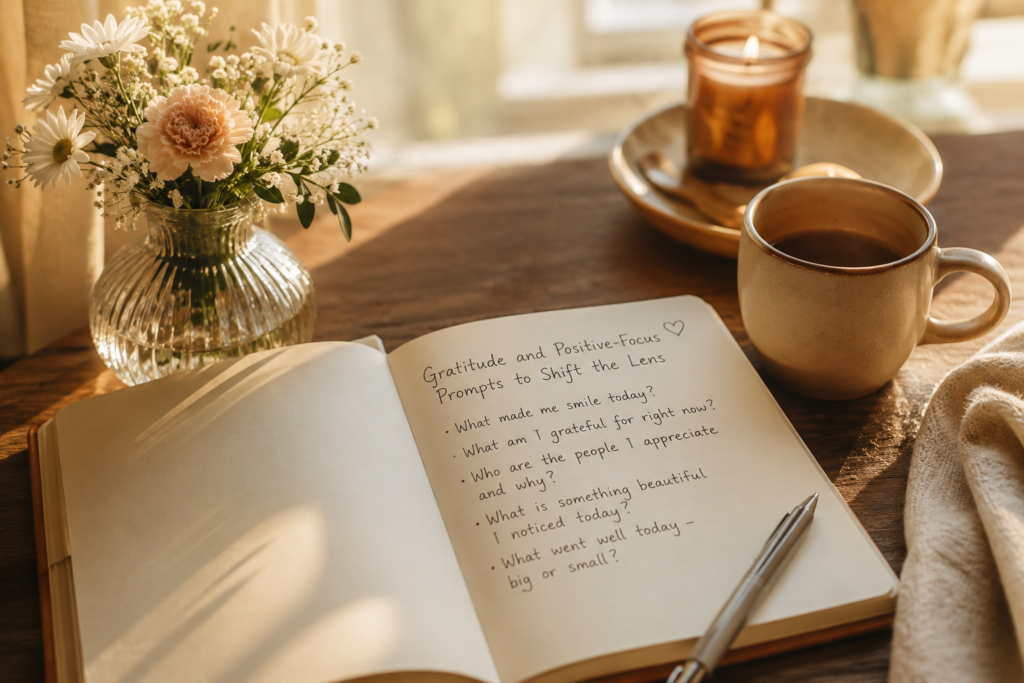
When anxiety has narrowed your whole world down to threats, deliberately writing about what’s good widens it back out — and there’s evidence this isn’t just feel-good fluff. A 2018 randomized controlled trial published in JMIR Mental Health had adults with elevated anxiety do short positive-affect journaling sessions a few times a week; over the following weeks, the journaling group reported less anxiety and mental distress and showed greater resilience than those who didn’t. The point isn’t to fake cheerfulness or pretend the hard things aren’t real. It’s to remind a fear-focused brain that good things exist in the same life as the worries.
A caveat worth respecting: forced gratitude can backfire when you’re in real pain, tipping into “I shouldn’t feel this way, other people have it worse.” So go specific and honest, not saccharine. These prompts help:
- Three specific things that went okay today, even tiny ones.
- One person I’m glad is in my life, and why.
- Something my body did for me today that I usually ignore.
- A small thing I’m looking forward to.
- One moment today I’d want to remember if this were a good day.
Specificity is what makes this land. “I’m grateful for my friends” is too broad to move anything; “I’m grateful Sam texted me back at the exact moment I was spiraling” actually reaches you.
Here’s how the five methods compare, so you can grab the right one for the mood you’re in:
| Method | Best for | A sample prompt |
|---|---|---|
| Brain dump | A crowded, racing mind | Everything I’m carrying today, in no order… |
| Challenge a thought | A specific, sticky worry | What’s the evidence this will actually happen? |
| Quiet overthinking | A loop going nowhere | What’s true right now vs. what I’m afraid of? |
| Gratitude / positive focus | Tunnel-vision on the bad | Three specific things that went okay today… |
| Expressive writing | A deeper, heavier event | My deepest thoughts and feelings about this are… |
Common Mistakes in Journaling for Anxiety
Plenty of people try journaling for anxiety, decide it “doesn’t work for them,” and quit — usually because of one of these fixable mistakes.
Trying to write beautifully. This is the big one. If you’re crafting nice sentences, you’re editing, and editing keeps you in your performing, self-conscious head — the opposite of the raw honesty that helps. No one will read this. Spelling doesn’t matter. Let it be ugly. Ugly is where the truth comes out.
Only ruminating on the page. Writing the same worry over and over, in more and more detail, without ever questioning or grounding it, can deepen the rut instead of breaking it. This is the trap of pure venting with no turn. The fix is the pivot: after you’ve gotten the worry out, ask one challenging or grounding question. Dump, then steer. Venting empties the cup; the questions are what calm you.
Forcing positivity too soon. Jumping straight to gratitude while you’re genuinely distressed often reads to your own mind as dismissal, and it stings. Let yourself name the hard thing first. Earn the gratitude by being honest about the difficulty before you reach for the good.
Quitting because you missed a few days. People treat journaling like a streak they’ve failed and abandon it entirely after a gap. It’s not a streak. It’s a tool you pick up when you need it and set down when you don’t. Missing a week means nothing. Open the notebook today and you haven’t lost a thing.
Saving it only for crisis nights. Like most of these skills, journaling works better as a light, regular habit than an emergency measure you’re learning from scratch mid-panic. A few minutes on ordinary days builds the reflex, so the page feels familiar when you really need it.
A note on the bigger picture. This article is educational and isn’t a substitute for professional care. Journaling is a genuinely helpful tool for managing everyday anxiety and overthinking, but it isn’t a treatment for an anxiety disorder, depression, or trauma. If anxiety is frequent, intense, or interfering with your life, please reach out to a doctor or therahe Brain Dumppist — these are common and very treatable. And if you ever feel unsafe or in crisis, in the US you can call or text 988 (the Suicide & Crisis Lifeline), free, any time.
Frequently Asked Questions

How does journaling help with anxiety? Journaling helps by moving anxious thoughts out of your head, where they loop without resolution, and onto paper, where they become specific and answerable. Naming a worry in words also engages the calmer, problem-solving part of your brain and creates a little distance from the feeling. Over time, writing about emotions has been linked to lower stress and better mood in research on expressive writing.
What should I write in an anxiety journal? Start with a brain dump — every anxious thought and task, unfiltered, for a couple of minutes. Then pick one worry and challenge it: What’s the evidence? What’s in my control? What’s the likely outcome, not the worst one? You can also list a few specific good things from your day. There’s no correct format; honesty matters far more than structure or neatness.
How long should I journal for anxiety? Less than you’d think. Two to five minutes is enough for a brain dump, and even the classic expressive-writing research used sessions of about 15 to 20 minutes. Short and consistent beats long and rare. If you only have two minutes before bed to empty your head onto the page, that genuinely helps. Don’t let “not enough time” stop you from a quick dump.
Can journaling make anxiety worse? Sometimes, if you only ruminate on paper — rewriting the same worry in more detail without ever questioning or grounding it can deepen the loop. The fix is to pivot after venting: ask a challenging or present-focused question, or note what’s in your control. Used that way, journaling settles anxiety rather than feeding it. If writing consistently spikes your distress, ease off and consider support from a therapist.
What’s the best journaling prompt for overthinking? A reliable one is: “What’s actually true right now, as opposed to what I’m afraid might happen?” Overthinking is almost always about an imagined future, so a prompt that pulls you back to the concrete present interrupts the spin. Pairing it with “What part of this is in my control?” helps you set down the parts you can’t change, which is usually most of what you’re circling.
Do I need a special journal or app to start? No. Any notebook, the notes app on your phone, or scrap paper works. The tool doesn’t matter; the habit does. Some people like a dedicated notebook because it builds a small ritual, and some prefer typing because it’s faster. Use whatever you’ll actually reach for when your mind is racing. The best journal is the one that’s within arm’s reach at 2 a.m.
The One Thing to Remember
The whole power of journaling for anxiety comes down to a single move: a worry trapped in your head is infinite and formless, but the same worry on paper is specific, finite, and answerable. Start tonight with two messy minutes and one honest prompt — you don’t need a system or a streak, just a pen and the willingness to be unguarded. The next time your mind starts looping, you’ll have somewhere to put it down.

Quiet the noise — without burning your phone in a field.
Get Beat Information Overload free, plus the occasional calm, no-hype note from me.